
|
|
WHO ATTENDS THE ELP? 
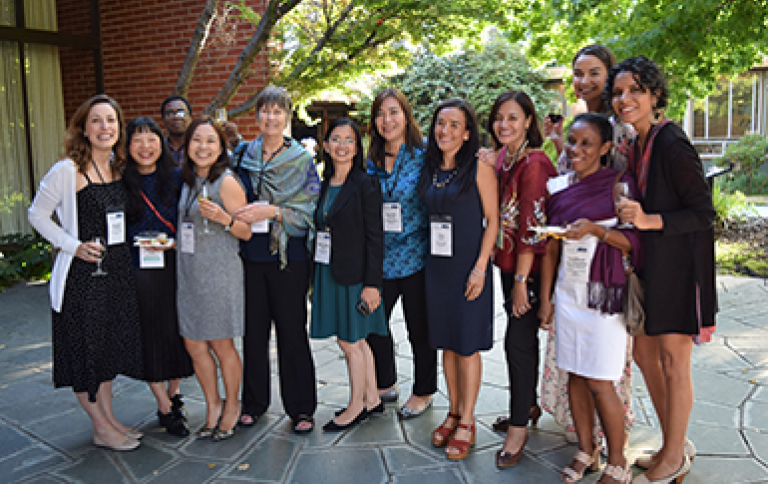
Since the inaugural Beahrs ELP summer certificate course in 2001, 268 people from more than 60 different countries have come to UC Berkeley for interactive training in Sustainable Environmental Management. Among the ELP Alums are agronomists, foresters, environmental lawyers and journalists, social and biological scientists and development practitioners, from non-profits, academia, the private sector and government ministries as well as international organizations such as the UN and CGIAR. Gender equity has almost been attained, with numbers of women increasing each year. Learn more about the Alums on the Alumni Network page.
HEAR INTERVIEWS WITH 2007 ALUMS
Three alums of the 2007 ELP summer certificate course in Sustainable Environmental Manangement - Alifah Lestari (Indonesia), Tahir Rasheed (Pakistan) and Emmanuel Wirsiy (Cameroon) were interviewed about their experiences in the course. Click here to hear the interviews on the web site of the College of Natural Resources, UCB.
|
 |
REPORTS FROM THE FIELD
Pakistani elections and assassination of Benazir Bhutto
Photo: AFP
January 17, 2008
Benazir Bhutto was killed at an election rally in Rawalpindi on 27 December 2007, twelve days before scheduled parliamentary elections. Elections have been delayed and will now be held on 18 February. The former Prime Minister had returned to Pakistan in October after years of self-exile.
The Bhuttos are one of the most famous political dynasties, as well as one of the most troubled. Banazir Bhuttos father, Zulfiquar Ali Bhutto, was prime minister of Pakistan in the 1970s. He was executed in 1979 after being imprisoned for two years. Ms Bhutto’s two brothers also died under suspicious circumstances.
Her 19-year-old son Bilawal has been chosen to take over her Pakistan People’s Party; he will be a titular head until completing his studies at Oxford University.
After her assassination, rioting erupted as supporters of Ms Bhutto’s Pakistan People’s Party ( PPP) expressed their grief. Friction between the party and the government will increase if the police arrest PPP workers for rioting and arson; thus far they have just compiled lists of thousands of names of those they claim were involved ( BBC Jan. 9.) Continued political instability in Pakistan seems inevitable in 2008.
Robin Marsh recently wrote to our Pakistani (and all) alumni: “Ever since the shocking news of the assassination of Ms. Benazir Bhutto late last month, I have been thinking about you, your feelings, your reactions, and how you are coping and managing in your respective communities and positions.” We have had several responses, two of which are excerpted here.
“Please accept my heartfelt gratitude for your concerns about the developments in Pakistan and the safety of the ELP leaders/fellows. Yes Pakistan is in turmoil and facing certain challenges due to its geo-political role. Every day it gets stranger and stranger - and more appalling. The year 2007 was worse as the will of the people was once again challenged by the destructive forces and what a loss.... this time, the lady who fought all her life to uphold the right of people to choose, to express, to live, brutally assassinated. Whether one agreed with her politics or not, with her ideology or not, no one can deny the serious blow to the civil forces in the society by her death. BBs politics in life left much to be desired, but the assassination - the criminal taking of life - serves nothing other than to plunge Pakistan into a more precarious and anarchic situation.
Having said that I think the situation in Pakistan is more than the indigenous. There are certain elements that plan to throw Pakistan to the brink of uncertainty, crippling its economy, creating political impasse and instability so their demands could be fulfilled accordingly. The main objective is to bring the people and the armed forces face to face, to prove the country a dysfunctional and failed state, and justify and pave the way for any adventurism in the name of…“terrorism”.
However the encouraging and positive thing is that the majority of our people blame the governments and not the people for all these developments. Perhaps I would not have agreed with them if I had not attended the ELP course and visited Berkeley. The views of the people about different international events, their logical critique on the Government policies and concerns were sources of encouragement that there are people who don’t like injustice and strongly believe in a “Live and Let Live” philosophy. (Tahir Rasheed, 2007)
“We have lived in a perpetual state of terror for far too long. Shall I call it an injustice of history or an inevitable consequence of our geography? We in Pakistan are very apt at contributing everything to conspiracy theories.
Yes, there can be a hundred and one theories of conspiracy but it is an undeniable fact that we are responsible for the mess that we are in. The turmoil in Afghanistan of the last few decades and our response to it has added to our miseries. The inability of our political bosses to rise above petty political expediencies and unite for a national cause has contributed too.
The incident of Bhutto’s murder underscores how grim the security situation in the country is. The death of at least 2000 people in acts of terrorism during the last year provides an insight into the extent of the menace. Benazir was a true leader of masses. I have never identified myself with her political ideology but my heart bleeds at her death.
Though I have a lot of unanswered questions but unfortunately there is no one who can help me find the answers. My country does not belong to militants. Here also like other parts of the world mothers love their children, poets write about the fragrance of flowers and the love of beauty. Here also people like to lead a life of dignity, honour and self respect. We are caught in a vicious cycle of violence, poverty and instability.” (Kazim Niaz, 2003)
|
ELP comments on post-election chaos in Kenya

Photo: AP
January 21, 2008
Since the contested results of 27 December 2007’s election results, Kenya has erupted into violence After the government of Mwai Kibaki declared him President on December 30, some 700 people have been killed, and a quarter-million have been displaced. Opposition protests led by supporters of Raika Odinga have been vigorously suppressed by the police, and many of the protests have degraded into inter-ethnic clashes.
Former United Nations Secretary-General Kofi Annan is now in Nairobi, as is Ugandan President Museveni, to encourage mediation efforts. Cosmas Ochieng, Policy Director of ELP’s close associate organization, Ecoagriculture Partners, wrote to describe the volatile atmosphere in Nairobi, where he is based, and to make the point that mediation is a process, not an event, and that it takes time. He also pointed out that all parties need to be interested in that process. The current government has rejected the term ‘mediation’, insisting that there is no crisis in the country. There is currently a ban on rallies and live broadcasts, though a new round of rallies and protests is being called for by Odinga supporters.
In response to our email of concern for ELP alumni, their families and communities, and the future of Kenya as a nation, we’ve heard back from many of you. Below are some excerpts from those emails describing the past weeks from their perspectives. Most who responded ultimately said they are looking forward to regained peace in Kenya, though many have suffered personal losses and are horrified by what is happening in their country. Many alumni and friends from other countries have sent messages of support.

Photo: AP
“Many thanks for your wishes, prayers and support at this difficult time of political divide in Kenya along tribal and ethnic dimensions. Paradoxically, the problem is historical and the current situation was not necessary but inevitable on the basis of a single decision by the chairman of the electoral commission announcing presidential results that he was not sure off.” (Patrick Karani, 2003)
“Kenyans voted for a reliable, hopeful and good leadership and not for political divisions characterised by ethnic hatred….” (Stephen Wanyoike Wamiti (Wams), 2005)
“Despite the pain and the loss, this has taught us to look deeply into our assumptions about ourselves, our fellow Kenyans, and address causes not the symptoms.
I have been in Nakuru in post-election duration, one of the hotspots, transit, and holding camp for the internally displaced persons. Seeing the people and hearing their traumatic stories of inhuman acts, rape, their painful experience is unbearable. My brother and uncle lost their homes, this only brought the experience right home... it is happening to peace-loving Kenyans, who happen to have a different dialect and historical origins.” (Muthoni Ngotho, 2003)
“The crisis in Kenya is affecting all of us. My family was based at Eldoret, scene of the worst clashes, and had to move under armed escort to Nairobi. Uganda, Rwanda, Burundi- eastern Congo- immediately affected by lack of fuel, whose prices went up fourfold before convoys brought new supplies.” (Simon Thuo, 2001)
“I live in Eldoret town, in western Kenya where fighting was fierce. I was confined in the house for 4 days and it is only today that I have had access to internet. ,,,,, Life is coming back to normal in the town and evacuation is ongoing.” (Eric Nahama, 2007)
“In short we are facing an unprecedented crisis. Kenya has been a promising democracy and symbol of hope for the region but may be we have been living in denial of the hard realities that characterise Africa; ethnicity, inequality, corruption, nepotism, marginalisation, etc all of which have now come to the fore, triggered by the flawed election. The Rainbow coalition of 2002 running on a platform of change never took off and the Orange Democratic Movement has just been nipped in the bud and so the violence. However, there can never be a justification for brutal killings and wanton destruction of property.
Every situation, however horrible, presents choices and opportunities. The tribal animosities currently in display present us with clear choices: we can choose to treat the symptoms by pretending that this is a passing post-election anger, or we can seize the opportunity to comprehensively address root causes.
Kenyans have the capacity and the will to change course for the better!” (Philip Kisoyan, 2002)
“This has taken us 40 years back...Let's believe that Kenyans will find a solution to this problem as I don't believe that this will be solved by foreign mediators.” (Abou Bamba, 2003)
“Neutral bystanders in Nairobi (central business district), Kisumu, Mombasa and Eldoret were engulfed in the clashes because once the police start confronting protesters anywhere near the major cities, they tend to order everyone - including those going about their normal legal business out of the cities; they block entries into the cities by both public and private means. Protesters in return barricade roads with stones and all sorts of obstacles (in one scary incident in Kibera last week, protesters derailed nearly 3kms of railway line - cutting off rail connection between Kenya and Uganda).
The mass rallies thus disrupt normal business and traffic because one's movement becomes very limited as one never knows when one might be chased out of town by police or have the road to one's destination blocked or barricaded. The end result is that most offices…were closed for a better part of last week and will remain closed during days slated for mass action by the opposition.,,,,,, “Subjectively, I believe in this country and I know a majority of the people here subscribe to certain fundamental democratic ideals - they will ensure that this political impasse is resolved amicably before thecountry degenerates into anarchy.” (Cosmas Ochieng, Policy Director, Ecoagriculture Partners)
“As local and national leaders, many of you are probably involved in seeking the solutions for this situation, and we are hopeful that your wisdom, creativity and skills will yield good results.” (Sara Scherr, President, President, Ecoagriculture Partners)
2008 is here with us. A country and its people are facing a crisis. Kenya. The international community is looking at the crisis from a tribalism perspective. I am at a loss to explain that tribalism is a very far fetched "reason" for the madness we are experiencing.
The problem is Kenya is not about tribes. It is about - access to resources, the rights to land, the economic disparities, modernity which requires you to own abut your own country denies you those rights of ownership (creating insecurity). I could go on.
Politicians have taken advantage of the situation and converted it to a tribal issue. This tribe this and this tribe that. And for the majority of those who can not make a living "within the promised greatness of modernity", it is obvious that the fault is not in the system but in a physical enemy in the form of tribe..... (Peter Kuria, 2001)
|