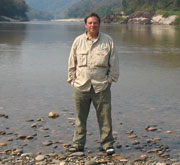
Dr. Resh

Research
Interests
The
research program in my laboratory follows three lines: 1) studies
on the evolutionary biology and ecology of aquatic insects,
crustaceans, and mollusks in stream and wetland habitats; 2) the evaluation
of habitat manipulations for use in environmental restoration
or
enhancement; and 3) the development of techniques for the
biological assessment of water quality.
The
ecological studies of aquatic invertebrates involve descriptive
and experimental approaches to life history studies, herbivore-plant
interactions, effects of disturbance, and other topics related
to population dynamics, biotic and abiotic interactions, and community
structure and function. These studies currently are being conducted
in California coastal streams and on the diadromous fauna in oceanic
island streams near the
UC
Berkeley research station in Moorea, French Polynesia.
Research
on habitat manipulations has been conducted in both running-water
and wetland habitats. In streams and rivers, emphasis has been
on developing and understanding of how hydraulic forces affect
the distribution of organisms, and how these forces can be modified
to enhance running-water habitats in stream restoration. These
approaches have been used in the habitat restoration of Strawberry
Creek on the U.C. Berkeley campus.
Research
in the biological assessment of water quality involves the
use of several long-term data sets (>10 years in duration) to
evaluate the natural variability in unperturbed systems, levels
of change
that occur in perturbed systems, and to use this information
in establishing thresholds to indicate whether impact has occurred.
Current research also includes the development of population,
community,
and ecosystem indicators for use in water quality assessment.
Related to these topics are the development of methods for the
evaluation
of mitigation procedures and habitat restoration programs.
Research sites include several streams in coastal California and
the 1,000-mile
long Fraser River catchment in British Columbia.
In
summary, the current and future research directions that I encourage
the students in my laboratory to pursue involve basic, quantitative
research in aquatic entomology and ecology, and the incorporation
of this research into a framework that can be used to solve applied
problems of water-quality assessment and habitat restoration. Graduates
from this laboratory continue to pursue these goals in universities,
environmental consulting firms, industries, and government agencies.
Selected Recent
Research Papers
Lawrence,
J. M. Deitch, and V.H. Resh. 2011. Effects of vineyard coverage and
extent on benthic macroinvertebrates in streams of Northern California.
Annales de Limnologie 47: 347-354.
Cover, M.R., J.A. de la Fuente, and V.H. Resh. 2010. Catastrophic
disturbances in headwater streams: the long-term ecological effects of
debris flows and debris floods in the Klamath Mountains, Northern
California. Canadian Journal of Fisheries and Aquatic Sciences 67:
1596-1610.
Lawrence, J.E., K.E. Lunde, R.D. Mazor, L.A. Bêche, E.P. McElravy, and
V.H. Resh. 2010. Long-term macroinvertebrate response to climate
change: implications for biological assessment in mediterranean-climate
streams. Journal of the North American Benthological Society 29:
1424-1440.
Statzner, B. and V.H. Resh. 2010 Negative changes in the scientific
publication process in ecology: potential causes and consequences.
Freshwater Biology 55: 2639-2653.
Resh, V.H. and D.M. Rosenberg. 2010. Recent trends in life-history
research on benthic macroinvertebrates, Journal of the North American
Benthological Society 29: 207-219.
Grantham, T.E., A.M. Merenlender, V.H. Resh. 2010 Climatic
influences and anthropogenic stressors: an integrated framework for
streamflow management in Mediterranean-climate California, USA.
Freshwater Biology 55 (Suppl. 1): 188-204.
Lacan, I., V.H. Resh, and J.R. McBride. 2009. Similar breakdown
rates and benthic macroinvertebrate assemblages on native and Eucalyptus
globulus leaf litter in California streams. Freshwater Biology
55:739-752.
Carter, J.L., A.H. Purcell, S.V. Fend, and V.H. Resh. 2009.
Development of a local-scale urban stream assessment method using benthic
macroinvertebrates: an example from the Santa Clara Basin, California.
Journal of the North American Benthological Society 28:1007-1021.
Bêche, L.A., P.G. Connors, V.H. Resh, and A.M. Merenlender. 2009
Resilience of fishes and invertebrates to prolonged drought in two
California streams. Ecography 32:778-788.
Mazor, R., A. Purcell, and V.H. Resh. 2009. Long-term variability
in benthic macroinvertebrate bioassessments: A 20-year study from two
northern Californian streams. Environmental Management
43:1269-1286.
Paul, M.J., D.W. Bressler, A.H. Purcell, M.T. Barbour, E. Rankin, and
V.H.Resh. 2009 Assessment tools for urban catchments: defining
observable biological potential. Journal of American Water Resources
Association 45:1-11.
Purcell, A.H., D.W. Bressler, M.J. Paul, M.T. Barbour, E. Rankin, J.L.
Carter, and V.H. Resh. 2009. Assessment tools for urban catchments:
developing biological indicators using benthic macroinvertebrates.
Journal of American Water Resources Association 45: 1-14.
Bressler, D.W., M.J. Paul, A.H. Purcell, M.T. Barbour, E. Rankin, and
V.H. Resh. 2009. Assessment tools for urban catchments: developing
stressor gradients. Journal of American Water Resources Association
45: 291-305.
Complete
Publication List
Curriculum
Vitae
Contact Information
Professor Vincent H. Resh
University of California,
Berkeley
Environmental Science, Policy, and
Management
Division of Organisms & Environment
201 Wellman Hall
Berkeley, CA 94720
(510) 642-6315 phone
(510) 642-7428 fax
resh@berkeley.edu