Home

  Professor Resh

  Grad Students

  Photo Gallery

  Sampling Videos

  Outside Resources


Joanie Ball

Background

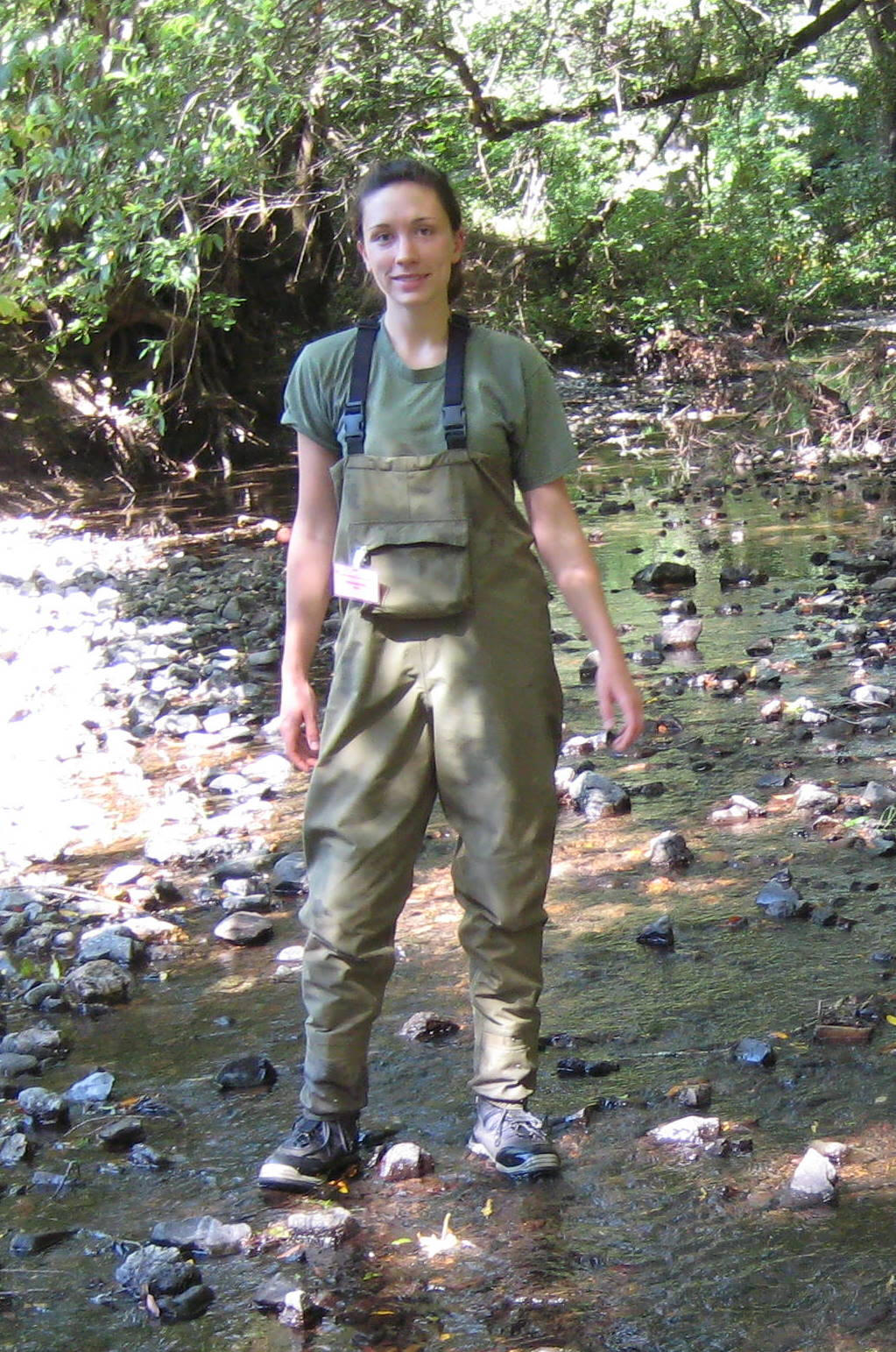
I received a B.S. in Environmental Studies from Emory University in 2005, and then worked for three years as an environmental scientist at a consulting and engineering firm. My work involved evaluating and remediating environmental contamination for urban redevelopment and industrial sites. I conducted historical environmental site assessments, and led groundwater monitoring projects for several sites throughout California. I also developed best management practices for construction sites, and managed storm water monitoring programs to assess nonpoint pollution sources to the San Joaquin River, San Francisco Bay, and Monterey Bay.

Research Interests

I am interested in the effects of historical and current habitat alterations on groups of aquatic macroinvertebrates with different life history traits. My research involves: 1.) using a microhabitat approach to develop indicators of sedimentation, 2.) determining how macroinvertebrate communities change as ephemeral ponds and streams dry out in California, and 3.) assessing the effects of landscape composition and pattern on the distribution of dragonflies with varying dispersal abilities. 

Cobble-Dwelling Macroinvertebrates as Indicators of Sedimentation

Sedimentation alters benthic habitat by homogenizing the streambed, and eliminating important microhabitats that macroinvertebrates and fish need to find food and refuge. Multi-scale studies have demonstrated that the impacts of increased fine sediment on macroinvertebrate communities are more significant on patches of varying sediment type than for individual streams or reaches. This is likely because benthic macroinvertebrates, which are small and relatively sessile, select habitat on a fine-scale. Microhabitat sampling underneath large cobbles may therefore be an effective and reliable method for developing macroinvertebrate indicators of sedimentation. I am currently evaluating the relative sensitivity of individual macroinvertebrate taxa and metrics to high cobble embeddedness to develop biological indicators of sedimentation.


Macroinvertebrates in Non-Perennial Streams


Climate change and intensive water use are creating increasingly dry conditions in arid regions, making the study of intermittent and ephemeral freshwater habitat more important than ever. Seasonal habitat transitions from flooding to drying extremes in non-perennial streams are associated with characteristic changes in macroinvertebrate taxa-composition, richness, average tolerance values, and functional feeding groups. Relatively few, and spatially-limited, studies have explored seasonal changes in macroinvertebrate life history traits during these extreme hydrologic transitions. I am evaluating whether characteristic changes in macroinvertebrate taxa and their life history traits occur as streams transition to intermittency in six Southern California non-perennial streams.   

Dragonfly distribution in the San Francisco Bay Area

Urbanization has impaired water quality, eliminated critical buffer vegetation, and in many cases has resulted in complete channelization or burying of streams and ponds. As a result, freshwater habitats have some of the highest extinction rates of all ecosystem types worldwide. However, we know relatively little about the distribution of freshwater organisms, particularly distribution changes that that have occurred over time. I am working with data from biological assessment samples, museum specimens, enthusiast group sightings, and additional field collections to determine how landscape alteration and climatic variables have affected the distribution of dragonflies in the San Francisco Bay Area.


Contact Information

Joanie Ball
Dept. of Environmental Science, Policy & Management
University of California, Berkeley
137 Mulford Hall #3114 (Resh Lab)
Berkeley, CA 94720

Phone: 510.642.5913
Fax: 510.642.7428

jball@nature.berkeley.edu